Our garden workshop season is in full swing in Stormont, Dundas and Glengarry! We started planning garden layouts at the beginning of March with students in Crysler at École élémentaire catholique Notre-Dame-du-Rosaire.
Since last fall, our partnerships with schools have expanded and we are thrilled to welcome two new schools to the GUO family: the Akwesasne Alternative School and North Dundas District High School!
Showing posts with label SD&G. Show all posts
Friday, May 2, 2014
Wednesday, November 27, 2013
Black Raspberry Vinaigrette
Increased awareness of how organic fruits are produced wasn't the only thing students took away from Hildebrand Farms last month. They purchased some organic black raspberries and as part of Growing Up Organic's Farm-Gate Café program, participated in a follow-up cooking workshop this week.
With the help of Jessica McLeod, a Registered Dietitian who works at the Seaway Valley Community Health Centre, students crafted their own healthy black raspberry vinaigrette.
Labels:
Cooking Workshop,
Farm-Gate Café,
Hildebrand Farms,
SD&G
Thursday, November 21, 2013
Un nouveau potager pédagogique à Crysler!
L'école élémentaire catholique Notre-Dame-du-Rosaire est la première école à construire un potager pédagogique en partenariat avec Grandir BIO en Stormont, Dundas et Glengarry!
Au printemps, ce potager sera utilisé comme outil d'apprentissage, principalement en cours de sciences. L'équipe de jardin à Notre-Dame-du-Rosaire (ce qui inclut des parents, une enseignante, le directeur et un membre du Centre de santé communautaire de l'Estrie) ont décidé de construire le potager cet automne afin d'être prêt à semer au début du printemps.
En utilisant des matériaux de construction offerts à l'école gratuitement ou avec une réduction par les entreprises locales, tous les élèves de l'école ont participé au projet de construction le 8 novembre 2013. Avec l'aide des parents bénévoles, les élèves du 4e, 5e, et 6e année ont construit les bacs de jardin. Comme il faisait froid dehors, cela était accompli au gymnase. Les adultes ont sorti les bacs à la cour d'école et les élèves de la maternelle au 3e sont venus aider les adultes à remplir les bacs avec le sol. En environ deux heures, un coin du cour était transformé. Merci à tous ceux qui ont aidé à construire cette formidable outil pour l'apprentissage et la sensibilisation à l'alimentation saine!
Pour en savoir plus au sujet de l'approche intégrée offerte par un potager pédagogique pour l'enseignement de l’éducation environnementale, veuillez nous contacter.
Au printemps, ce potager sera utilisé comme outil d'apprentissage, principalement en cours de sciences. L'équipe de jardin à Notre-Dame-du-Rosaire (ce qui inclut des parents, une enseignante, le directeur et un membre du Centre de santé communautaire de l'Estrie) ont décidé de construire le potager cet automne afin d'être prêt à semer au début du printemps.
En utilisant des matériaux de construction offerts à l'école gratuitement ou avec une réduction par les entreprises locales, tous les élèves de l'école ont participé au projet de construction le 8 novembre 2013. Avec l'aide des parents bénévoles, les élèves du 4e, 5e, et 6e année ont construit les bacs de jardin. Comme il faisait froid dehors, cela était accompli au gymnase. Les adultes ont sorti les bacs à la cour d'école et les élèves de la maternelle au 3e sont venus aider les adultes à remplir les bacs avec le sol. En environ deux heures, un coin du cour était transformé. Merci à tous ceux qui ont aidé à construire cette formidable outil pour l'apprentissage et la sensibilisation à l'alimentation saine!
Pour en savoir plus au sujet de l'approche intégrée offerte par un potager pédagogique pour l'enseignement de l’éducation environnementale, veuillez nous contacter.
Labels:
Construction de bacs,
Garden Building,
SD&G
Thursday, November 7, 2013
St. Matthew's Visits Hildebrand Farms
On a chilly Friday October 23rd, students from St. Matthew's Catholic Secondary School headed north from Cornwall to visit Hildebrand Farms, a farm with a young orchard and berry farm. Bryan Hildebrand, the farmer, guided students on a tour of the farm, highlighting the business planning that goes into such a project.
In the two and a half acre (roughly one hectare) orchard, Bryan explained that it takes about five years for the trees to begin producing fruit, so it's important to use research and math to estimate the expected yields so that you can plan your business and cash flow. Bryan plans for an estimated five to ten percent of the trees dying off in the first few years of planting. While disease and insect pests pose a threat to trees, Hildebrand Farms also has to protect trees from hungry mice and deer. Plastic covers on each of the tree trunks are put in place each fall to prevent mice from destroying trees over the winter, and a solar powered electric fence protects the 600 trees from deer.
Hildebrand Farms plans to have a pick-your-own option for raspberries and blueberries, providing a local organic option for families from Cornwall. Bryan explained they are also considering a pick-your-own option for the fruit trees, but that pick-your-own operations in orchards require a bit more supervision by the farmer in order to insure customers know how to pick the fruit without damaging the trees.
contact the project coordinator or manager for your region.
In the two and a half acre (roughly one hectare) orchard, Bryan explained that it takes about five years for the trees to begin producing fruit, so it's important to use research and math to estimate the expected yields so that you can plan your business and cash flow. Bryan plans for an estimated five to ten percent of the trees dying off in the first few years of planting. While disease and insect pests pose a threat to trees, Hildebrand Farms also has to protect trees from hungry mice and deer. Plastic covers on each of the tree trunks are put in place each fall to prevent mice from destroying trees over the winter, and a solar powered electric fence protects the 600 trees from deer.
Hildebrand Farms plans to have a pick-your-own option for raspberries and blueberries, providing a local organic option for families from Cornwall. Bryan explained they are also considering a pick-your-own option for the fruit trees, but that pick-your-own operations in orchards require a bit more supervision by the farmer in order to insure customers know how to pick the fruit without damaging the trees.
![]() |
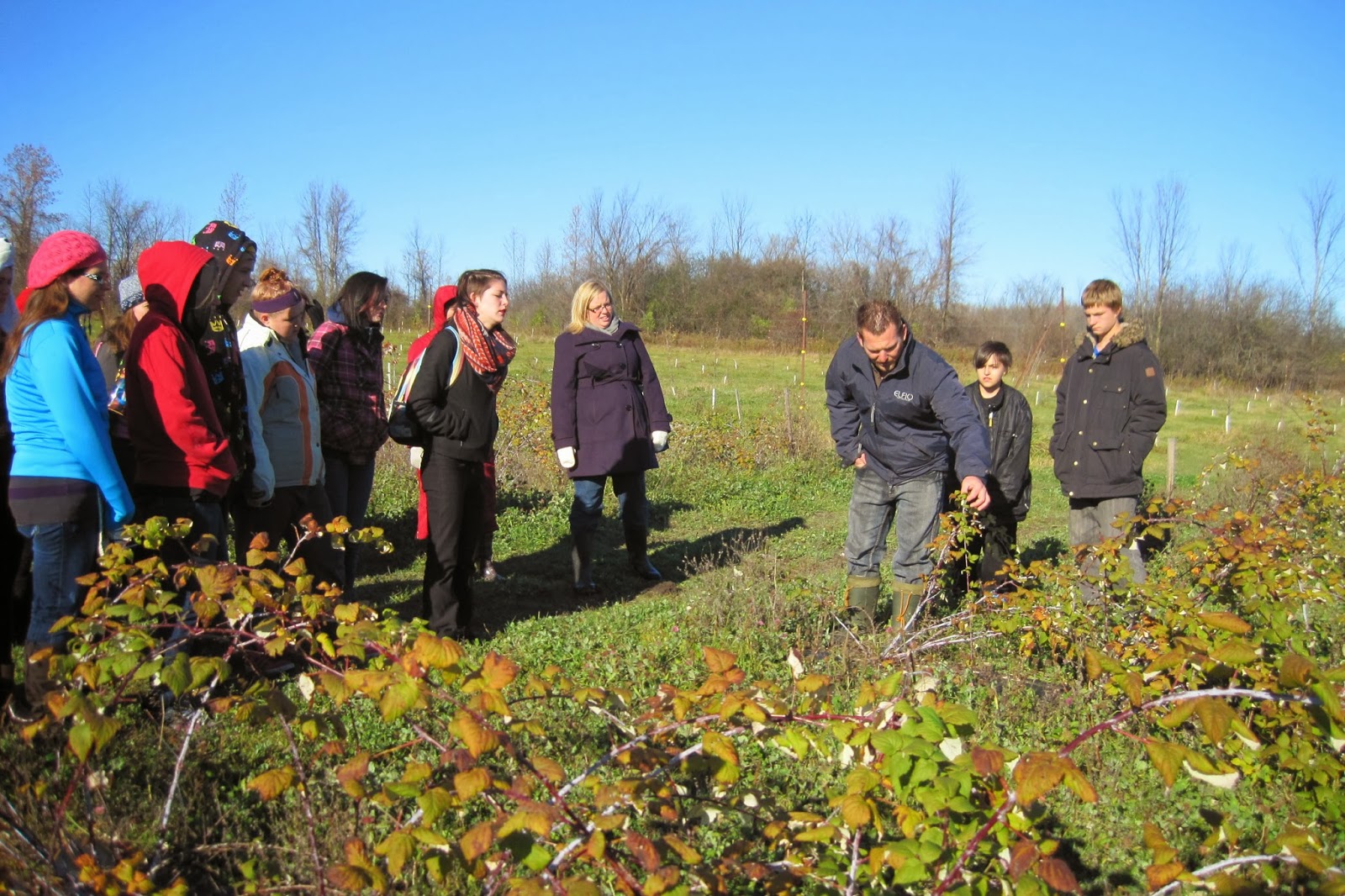
| Students learned about black raspberries, and were intrigued by the fact that when the raspberry canes grow tall enough, they flop over and root in the soil. |
One of the aspects Bryan highlighted was the degree to which he uses experimentation to expand the business. For example, the blueberries have done well, so they are now expanding that aspect of the farm. On the other hand, in a planting of 36 heartnut trees (students were intrigued to learn that this walnut relative is actually heart shaped!) only three have survived. Bryan explained that he will likely wait until the surviving trees are bigger, and propagate them, in the hopes that the surviving trees are better adapted to local conditions.
In the blueberry field, students took cuttings from the existing plants and helped prepare them for rooting in containers of sand. The completed containers will spend the winter in a cold storage facility (at about refrigerator temperature) and be planted in the spring to increase the size of the blueberry patch.
contact the project coordinator or manager for your region.
Labels:
Berry Farm,
Farm Field Trip,
Farm-Gate Café,
Hildebrand Farms,
Orchard,
SD&G
Subscribe to:
Posts (Atom)


