Wednesday, November 13, 2013

Devonshire visits Roots and Shoots

Early last Wednesday morning, Devonshire Grade 3 students braved the grey November skies and headed South of Ottawa to visit Roots and Shoots Organic vegetable farm. Once on the we met Robin Turner, the organic farmer himself, and Danny, one of his employees. Robin wanted the uniqueness of Roots and Shoots to sink in, so we started by playing a game, learning about the "Global Industrial" food system versus the "Local Sustainable" food system.

Danny then took us on a small tour, showing us one of Roots and Shoots' large greenhouses. Swiss chard, spinach and dinosaur kale were all happily growing away and to our surprise, Danny and Robin can harvest these greens well into December, all thanks to the heat of the sun captured by the greenhouse!


We then headed to the fields where the last potatoes of the season were waiting for us to be harvested. 

In no time at all we had buckets and buckets!

Before leaving the farm, we loaded up a 50 lb bag of carrots to bring back to school. We thought about the average carrot and it's journey from farm to plate and how different it was from the organic carrots from Roots and Shoots. The carrots we were bringing back to Devonshire were grown without pesticides or other dangerous chemicals and were grown with care not a twenty minute drive from where they would be eaten. Roots and Shoots also sells directly to its customers - this means Robin gets a fair return for wares and speaks to his customers face-to-face  ...Now we were hungry for carrot soup!

Thursday, November 7, 2013

St. Matthew's Visits Hildebrand Farms

On a chilly Friday October 23rd, students from St. Matthew's Catholic Secondary School headed north from Cornwall to visit Hildebrand Farms, a farm with a young orchard and berry farm. Bryan Hildebrand, the farmer, guided students on a tour of the farm, highlighting the business planning that goes into such a project.

In the two and a half acre (roughly one hectare) orchard, Bryan explained that it takes about five years for the trees to begin producing fruit, so it's important to use research and math to estimate the expected yields so that you can plan your business and cash flow. Bryan plans for an estimated five to ten percent of the trees dying off in the first few years of planting. While disease and insect pests pose a threat to trees, Hildebrand Farms also has to protect trees from hungry mice and deer. Plastic covers on each of the tree trunks are put in place each fall to prevent mice from destroying trees over the winter, and a solar powered electric fence protects the 600 trees from deer.

Bryan talks about orchard planning, pruning, and protecting trees from mice.
Students were surprised to learn that the plastic around the trunk of the tree prevents mice from damaging the orchard in the winter. "I feel sorry for the mice!" remarked some students – Bryan assured them that there are plenty of other things for the mice to eat on the farm, such as seeds and grasses!
Bryan talked about the need to prune the trees in the orchard, explaining that the trees often look like they have had a haircut. Keeping the tree pruned lets sunlight reach the fruit, and also makes it much easier to pick. Bryan also talked about the need to monitor tree health to address any issues early. For example, black knot requires removing the affected branch (or tree) and burning it.

Hildebrand Farms plans to have a pick-your-own option for raspberries and blueberries, providing a local organic option for families from Cornwall. Bryan explained they are also considering a pick-your-own option for the fruit trees, but that pick-your-own operations in orchards require a bit more supervision by the farmer in order to insure customers know how to pick the fruit without damaging the trees.
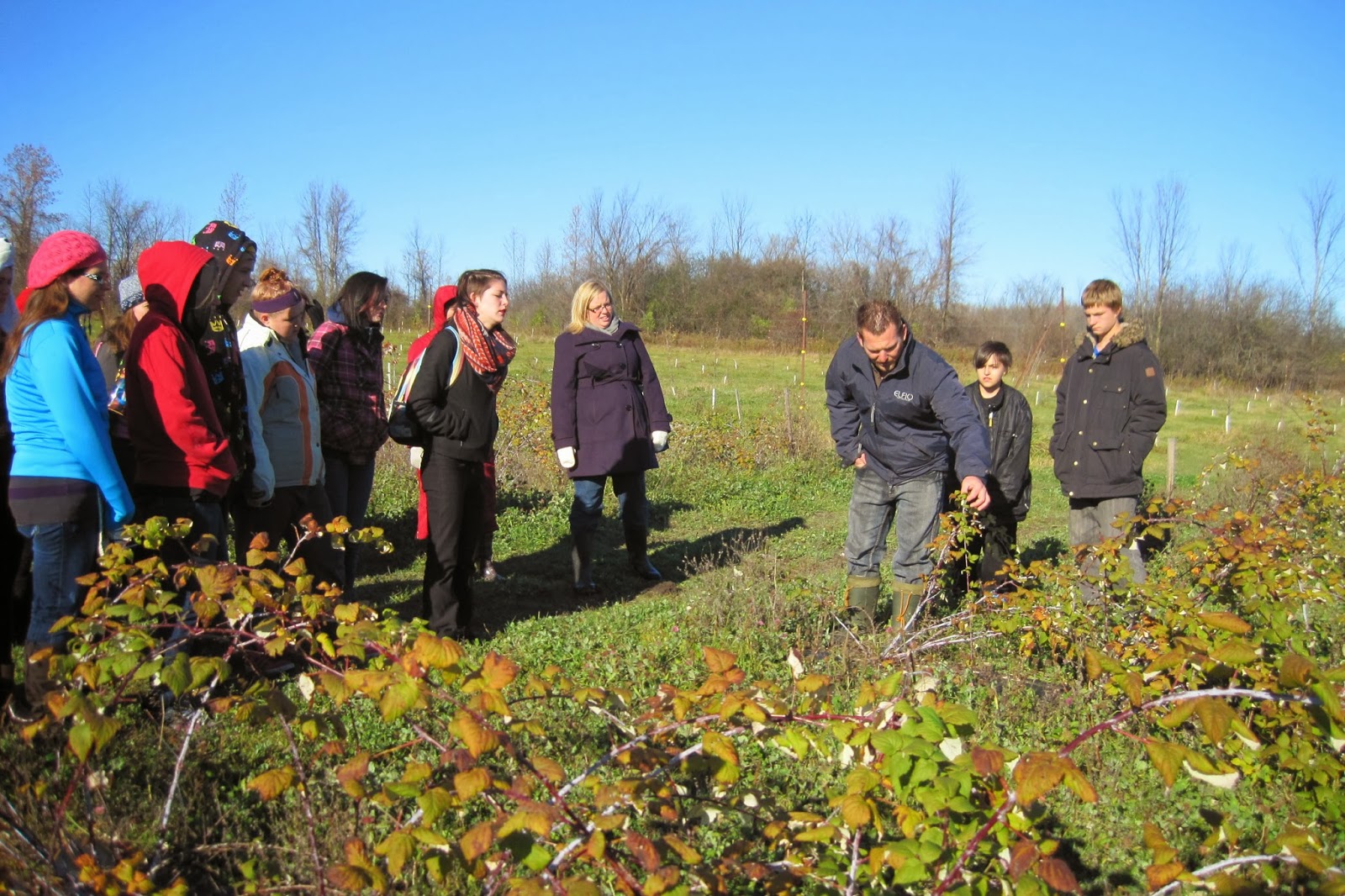
Bryan describes how black raspberries are cultivated, as well as how the canes (plants) flop over onto the soil and root.
Students learned about black raspberries, and were intrigued by the fact that when the raspberry canes grow tall enough, they flop over and root in the soil. 

One of the aspects Bryan highlighted was the degree to which he uses experimentation to expand the business. For example, the blueberries have done well, so they are now expanding that aspect of the farm. On the other hand, in a planting of 36 heartnut trees (students were intrigued to learn that this walnut relative is actually heart shaped!) only three have survived. Bryan explained that he will likely wait until the surviving trees are bigger, and propagate them, in the hopes that the surviving trees are better adapted to local conditions.

In the blueberry field, students took cuttings from the existing plants and helped prepare them for rooting in containers of sand. The completed containers will spend the winter in a cold storage facility (at about refrigerator temperature) and be planted in the spring to increase the size of the blueberry patch.

Students help propagate blueberries.
Students helped select cuttings from the blueberry patch and prepared them to root over the winter. With a little luck, in the spring the cuttings will have developed roots and be planted out in the blueberry field. 
Students left with some black raspberries, which they will transform into a healthy recipe with the help of a local dietician in a follow-up cooking workshop. This innovative part of Growing Up Organic's Farm-Gate Café helps students see the entire farm to plate cycle. For more information about Farm-Gate Cafés or to inquire about organizing one for your class in the spring, please contact the project coordinator or manager for your region. 

Friday, June 14, 2013

GUO’s Farm Field Trip Series, Spring 2013

Heritage Academy at Juniper Farms
On Monday, May 13th, the grade 7 students and the gr 10 Green Industries students of Heritage Academy kicked off the farm field trips of 2013 at Juniper Farms. Although it was a cold morning in Wakefield, QC, students were greeted with warm welcomes by Alex, his lovely wife Juniper, and their friendly Australian Shepherd, Clover.


 The students were surprised to learn that Juniper Farms sells most of their produce to restaurants and something they had never heard of before; community supported agriculture (CSA) baskets. Alex explained that by signing up for a CSA basket at the beginning of the season, the members are delivered vegetables that came out of the ground that same day. Now that’s freshness at its best!

Students were excited to check out the machinery on the farm. One of Juniper Farms’ most prised possessions is a machine called a spader. This machine is used for tilling the land, but is much better for the soil than a conventional plough as it digs deeper and is friendlier to the earth worms!
Finally, we got our hands a little dirty and helped out on the farm by weeding buckwheat seedlings from the spinach field. All in all, it was a great time had by all! Thanks to Alex and Juniper for having us on your beautiful farm!

/The new mobile chicken coop!
Weeding with Clover the dog!
Farmer Alex talks about a spader.


Churchill Alternative School  at Rainbow Heritage Farms
On Thursday, May 16th, Farmer Zach welcomed the excited grade 6 students from Churchill Alternative to Rainbow Heritage Farms in Cobden, ON. One of the very first things that caught the students’ eyes was the yurt that Zach and his family live in!

Zach started off his tour by  relating the importance of a great diversity of plants and animals on his farm: Zach not only means having a great variety of vegetables, but also diversity throughout time: short term crops like annual vegetables, medium-term plants like perennial asparagus, raspberries, onions, and the long-term investments: the mighty trees. Rainbow Heritage is located on part of the Canadian Shield, large expanses of rock formed by the last glacier age; the tall and mighty oaks have been slowly grinding away at the soil throughout the ages and now Zach says, this is the best soil he has ever seen. Zach has learned from the trees and now continuously builds up the soil on his farm and plants new trees for generations to come.


After a “jogging tour” around the farm, Zach invited us to plant four oak trees in a field. This is just one of Zach’s long term projects on the farm. He hopes to recreate the type of forest that would have existed on his farm a long time ago. How nice would it be for the students to come back to Rainbow Heritage as adults and see how their trees have grown?


Last but not least, it was Churchill Alternative’s turn to help out on the farm! The students helped to lay down mulch around walnut and spruce saplings. It was another fantastic day for city kids to take a walk on the rural side!


Summit School visits Castor River and Roots & Shoots Farms
On Wednesday, May 22nd, the grade 8 students of Summit Alternative School split up into two groups for the day. One group got to visit an organic vegetable farm, while the other was off to see an organic grain farm. The idea was to give each group a different organic farm to visit so that they could compare the similarities and differences they observed on these farms at the end of the day.

Castor River
Farmer George welcomed the grade 8 students to his organic grain farm in Metcalfe, ON. The students quickly gravitated towards the charming farm animals at Castor River Farm, including two dairy cows, many chickens, even more pigs, a Clydesdale horse, and a grumpy old pony. After a quick introduction to the farm, George was ready to put us to work by helping him move the electric fence used to contain the horses and cows so that they could graze on new grass. Don’t worry, the power was turned off!
Castor River Farm, includes many fields used to grow wheat, rye and corn. George’s farm is roughly 40 acres whereas a typical grain farm could cover up to 4000 acres! But George explained that he was able to stay competitive by being one of the few organic grain farms in the region.

Afterwards, we helped to trim the apple and pear trees in the orchard, collect eggs in the chicken coop, and grind up some wheat on the bicycle-powered mill! The students were able to grind a whole bucket full of flour!

All of that hard work paid off as the students brought home buckwheat flour and maple syrup to make pancakes at school that week. Thanks Castor River Farm!


Roots and Shoots
The other half of the grade 8 students enjoyed their farm field trip at Roots and Shoots Farm, in Manotick Station, ON. Farmer Robin and long-time farm employee, Danny, greeted the students and gave them a tour of the farm. There were many broad topics discussed throughout the morning, including making good food choices, buying local and organic produce, and global food issues.

The grade 8 students also learned a lot about hard work as they helped mulch a field with straw. Although it was a hot, dirty, and itchy job, it was clear that the students were having a great time! Thank you to Roots and Shoots Farm for the insightful and adventurous day!


Elmdale Visits Rollway Hops
On Thursday, May 23rd, the grade 3 students of Elmdale Public School visited Rollway Hops Organic farm in Plantagenet, ON. One by one, the students came off of the bus in their rubber boots and rain coats, to be greeted by Jacques and his sister, Roxanne. Soon enough it was pouring rain but that didn’t stop us! The morning started off with a tour of the managed forest surrounding the farm where Jacques and Roxanne practice foraging. In the woods, the students got to see the sugar shack, pick wintergreens, learn how mushrooms are grown on logs, and find lots of moose droppings!

Back in the greenhouse, Jacques let each student pick their own radish and plant their very own bush bean or nasturtium seed. Roxanne was also kind enough to serve the students a lime and mint infused sweet drink and candied spruce shoots. Everything was delicious! The students couldn’t believe that you could eat something growing off of a spruce tree.


Rain or shine, Elmdale students are ready for the tour!


When it was time to get back on the bus, Jacques had one more sweet treat for the students to try before leaving….maple syrup from the farm. With a spoonful of syrup, the students went back to school with their potted beans and nasturtiums.

Thank you to Jacques and Roxanne for a wonderful day at Rollway Hops Farm!


Wednesday, June 12, 2013

Salad Days at Cairine Wilson

What a treat today to share the "vegetables of our labour" with students at Cairine Wilson Secondary School in Orleans! The salad days of June are upon us and students of Cairine Wilson's grade 11 biology and community living classes aren't wasting any time making a feast of their garden harvest.
Harvesting mustard greens and radishes for today's salad
Cairine Wilson School is among the newest partners of Growing Up Organic. When we started the garden together back in early April, Ms. Robin and Ms. Arnot were keen to have the garden be a chance for their two classes to combine their efforts and give them an opportunity to work together. Their garden has blossomed under this model, allowing students to learn as much from the garden as they are from their experience together - preparing a salad feast together today was no exception. 
Taste testing.....White Icicle Radishes and German Giants!
We gathered a huge harvest today - what a surprise! It seems like just yesterday we were planting tiny seeds in the ground! Radishes and lettuces were eager to be picked and savoured....Look at that bounty!

Working with students in the DDU at Cairine Wilson, and allowing them the opportunity to contribute in such a meaningful way to their school's community, as well as impact the bigger picture by practising organic principles, has been an exceptionally enriching experience.
Gathering for a well-earned meal
In the fall, students will return to see the results of their careful planning of a three sisters plot: where corn, squash and painted mountain corn are now slowly popping up. In the meantime, keep the salad coming! Thank you for the invitation to lunch Cairine Wilson, looking forward to the fall!
The three sisters plot...what will it look like in September?!


Saturday, May 18, 2013

Hilson Avenue Roots for Scallop Squash!


Hilson Avenue public school is one of the newest schools in Ottawa to green its schoolyard and incorporate an organic vegetable garden. When I contacted Hilson Avenue back in February, they were in the midst of a long term grand project to green their schoolyard located in Westboro. An organic vegetable garden seemed like a natural fit...they agreed! Since then, the garden project has blossomed, thanks in large part to two dedicated B. Ed. students who chose to pursue the garden at Hilson, as a social action project, something students are encouraged to design through the Global Cohort program of Ottawa U's B. Ed. program. 
Thanks to Laura and Ailsa, eight teachers at the dual-track school are now participating in the garden project. The project at Hilson is an exemplary look at how school gardens can be used as educational tools across the curriculum, while providing and opportunity for students to be directly engaged in the design of their own school, instilling pride and in their surroundings and appreciation for their environment. Hilson Avenue's engagement also showcases how educators can build off Growing Up Organic's workshops, to integrate the garden into their pedagogy everyday by creating their own garden-based lessons and activities.
Early in the spring, Laura and Ailsa invited two classes to begin work on a garden care manual. Students researched the different vegetables that would be planted in the garden and created a bilingual booklet that includes instructions on how to plant the seeds, how to care for the plants as they grow, when to harvest them, and some ideas for enjoying the harvest!
Hilson Avenue Manual: Beets2013-05-17 13.17.54
A couple weeks ago, students got to work planting the first seeds outside, and creating artistic signs to identify their vegetables and add colour to the garden.
IMG_4460
Yesterday, it was time to start squash seedlings. We started by identifying 17 edible seeds we could find in the kitchen: corn, rice, kidney beans, wheat, lentils, and even tiny mustard seed! Then we got to work planting heirloom varieties of summer and winter squash: yellow bush scallop squashes, table queen winter squash and yellow straightneck squash.
2013-05-17 14.04.26
Thank you Hilson Avenue Public School for your enthusiasm and hard work! Don't forget to water!!
 
Everyone say....1, 2, 3...Scallop Squash!!

Wednesday, April 10, 2013

Preparing for a Great Gardening Season at Devonshire Public School!

While it is still too early to plant certain vegetables outside, the students at Devonshire Public School knew there was still work to be done by planning out their school garden and getting their seeds started indoors. Growing Up Organic visited three classrooms on April 8th to gear up for this season’s vegetable garden.


The fourth graders were excited to lay the groundwork for this year’s garden. The morning started out with a lively discussion of what is meant by the word “organic,” establishing the fact that all plants need the proper amount of space to grow, and learning about “companion planting.” How do plants help each other in the garden? We came up with lots of ideas! Certain plants can help each other out by providing shade! Others deter insects, or even add nutrients to the soil! With this knowledge in hand, the fourth graders worked hard at planning out a map of the vegetable garden, square foot by square foot, ensuring that each vegetable had its “companion” close by to help the vegetables grow strong and stay healthy.

After creating a well thought-out garden map, the next thing to do was get some of the vegetables started indoors so they could be ready in time for harvesting. Luckily, the grade 3 and grade 2/3 classrooms were eager to get their hands dirty and plant some seeds. The students were excited to learn all about seeds. After inspecting a variety of seeds that could be found in their home pantries, each student was able to examine the different parts of a seed by dissecting a soaked lima bean.


Once the students identified the seed coat, the cotyledons, and the plant embryo, it was time to plant seeds! Choosing between varieties of tomatoes, cucumbers, and lettuce, each class ended up with a diverse selection of seeds getting a head start in their compostable pots.


Within a few weeks, the students will be helping to rebuild their garden bed to ensure that the plants will have a secure environment to thrive in once they are transplanted. Thanks to the students’ enthusiasm and hard work at Devonshire Public School, it was a great start to the gardening season!

Mapping it Out! Connaught Students Learn the Importance of Space and Companion Planting


Early in the morning on April 10th, the students at Connaught Public School were excited to welcome Growing Up Organic back to their school and begin planning for their school garden. The morning began with a discussion in the grade 5 classroom about what was successful in the garden last season and what the students wished to create with their harvest this year. Lasagna is on the menu! 

Once the class came up with a list of vegetables and herbs, it was time to plan out a map of the garden. The students learned about “companion planting” as a gardening technique and were eager to find ways of placing certain vegetables together that would help each other grow. By working together, the grade 5 classroom created a beautiful map of their vegetable garden.


The grade 3 students were just as enthusiastic about planning out their vegetable garden. Just to make sure the students understood how important it is for plants to have space, a fun experiment was conducted. The students pretended to be the seed of their favourite vegetable by curling up into a ball on the classroom carpet. They started to “grow” as they were given water, sunlight, and nutrients from the soil. As they stretched out their roots, stems, and leaves, they quickly realized that their vegetables were too close together and were running out of SPACE! With the lesson learned, it didn't take long for the grade 3 students to come up with an equally beautiful and well thought out vegetable garden.


 With two detailed maps for their garden beds, the students at Connaught are looking forward to implementing their plans so they can get into the garden and start growing their vegetables!