Sunday, January 6, 2013

The Growing Healthy Communities Forum is back!


The second annual Growing Healthy Communities Forum is here! 
Please note DATE CHANGED below!

Date/Time: February 28th 2013, 5pm-8:30pm
Place: Heritage Academy, 207 Bayswater

attendance by donation (please register ahead of time at: http://growinghealthycommunitiesforum.eventbrite.ca/)

The purpose of this forum is to celebrate initiatives that increase access to healthy, nutritious, sustainable food for children and youth in Ottawa.  This year, the forum will  focus on healthy, local, sustainable food in schools as well as innovative responses to the new Ontario School Food and Beverage Policy.
The topics for discussion will include:
1. Making the most of your school Garden: Garden‐based student learning opportunities across the curriculum
2. Healthy, kocal, organic: Your school's student breakfast and snack program
3. Inspiring healthy eating: Best uses for your school garden produce
4. School composting: Challenges and solutions
5. Farm-to-School: Connecting with local organic farms
Do you have an idea for a discussion topic? Or would like to speak about your school's innovative program? We are currently welcoming potential speakers and discussion faclilitators to submit proposals. Please feel free to email growinguporganic@gmail.com or lindsayvyvey@gmail.com with your suggestions!

Sunday, November 4, 2012

A Visit to Parkdale Farmers' Market with Devonshire Public School

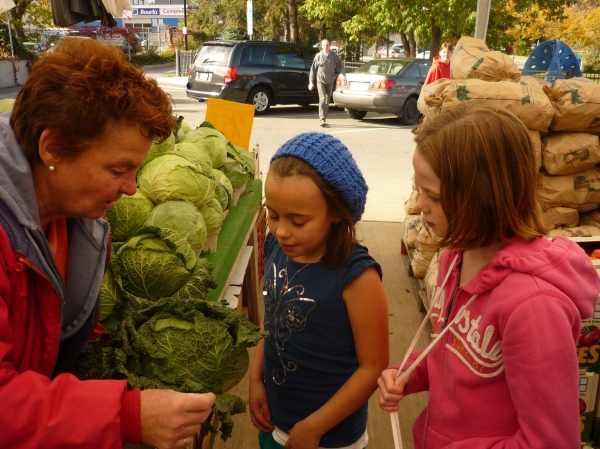
On a beautiful, sunny day in October, 4th graders from Devonshire Public School went on a special field trip to the Parkdale Farmers’ Market. It was an excellent opportunity to talk about important food issues for urban consumers. Before heading out on their field trip, the students brain-stormed some questions to ask the people working at the market. These questions were based on their knowledge of organic and conventional production, the meaning of local produce, and the differences between vendors and producers at the market.

One of the great things about this field trip was its relevance to the students’ daily lives; they were actually able to walk from their school to the farmers’ market! Utilizing local resources, such as the Parkdale Farmers’ Market, in an educational context allows the students to see the connections between their daily lives and what they are learning about in school.


At the market, the students were full of great questions for people at every stall of the market. Walking around the market, I heard questions like “Is this garlic local? Where is it grown?” and “Do you use pesticides on your vegetables?”. The students’ enthusiasm in learning the answers to their questions was a testament to the importance of food education in our schools.


While at the market, the students bought produce to make a green tomato salsa and a Greek salad. When they returned from the market, they had the opportunity to use all of the ingredients that they bought to make snacks for themselves and visiting students from Connaught Public School.

It was definitely a very special trip, and another inventive way to integrate food education into schools. A big thanks goes out to Mr. Stephen Skoutajan at Devonshire for organizing the trip, and to all of the parent volunteers for their help!


Saturday, October 20, 2012

Connaught Public School visits Mariposa Farm!

On a beautiful fall day in October, 3rd and 5th grade students from Connaught Public School had the opportunity to visit Mariposa Duck and Goose Farm. Ian Walker and Suzanne Lavoie, along with their trusty crew of farm animals, hosted two classes on the farm. The day started off with a grand tour of the farm, where the students had the opportunity to see the farm's diverse vegetable gardens and meet the farm's resident ducks, geese, pigs, and horses. To the great delight of the students, they were also accompanied on their tour by Yoga, the farm's incredibly friendly and loving Jersey cow.
As a part of the tour, Ian taught the students about the tradition (often referred to as the 'three sisters') of growing sweet corn, beans, and squash together. The students then had the opportunity to help harvest butternut squash from Ian's abundant vegetable gardens. This was a special opportunity, as the kids had an absolutely amazing time, running around harvesting butternut squash, and it was also an opportunity to express their gratitude to the farm for inviting them to visit. They harvested a whole truck full of squash in about half an hour, which would have taken one farmer much longer to do!


After harvesting the squash, the high quality squash was separated from the lower quality squash, and the students got to feed some squash to the pigs! They were amazed at how quickly the pigs gobbled up the squash, and how much they enjoyed it. It was one more lesson for them on how, on a farm, everything can have a use, and nothing need be wasted.
Ian also taught the students about the importance of saving seed from the crop. The students dug around in some large squashes, and separated the flesh of the vegetable from the seeds. These seeds will then be dried and saved to plant next year.
All in all, it was an amazing day for everyone involved. Thanks to Anne Sherman and Michelle Richardson at Connaught Public School for their hard work in organizing this trip, and a huge thanks to Ian and Suzanne at Mariposa Farm!


Saturday, August 11, 2012

National Farm to Cafeteria Conference

It was a whirlwind learning adventure last week as I joined over 800 attendees at the 6th National Farm to Cafeteria Conference in beautiful Burlington, Vermont. As a chance to interact with movers and shakers in the farm-to-school movement, the conference could not have been more successful; GUO connected with groups across the U.S. and Canada working hard to bring  healthy and sustainable food to children and youth in and outside the classroom, while connecting schools with their local agricultural community. 

I was particularly impressed with the legislative support and representation at the conference; as many of you know the landscape of farm-to-school in the U.S. is very distinct from the Canadian experience, not least because of the national school lunch program. One of the most striking differences is the engagement of political actors in advancing these important causes: from Michelle Obama's "Let's Move!" campaign, to the very recent implementation of a National Farm to School Grant Program, housed in the US Department of Agriculture. Present at the Digging In Conference were Congressman Welch, Congresswoman Chellie Pingree, Senator Sanders, and Chuck Ross (Secretary of the Vermont Agency of Agriculture); making video appearances were Kathleen Merrigan (USDA Deputy Secretary) and Deborah Kane (USDA National Director of Farm to School) among several others. The depth of knowledge and inspiring messages from these speakers convinced me of the need for similar champions in Canada and the overall importance of government support for programs dedicated to increasing the health of our youth, supporting a sustainable environment, and linking us more closely with our local sustainable agricultural community. Thanks to the support of these individuals and the tireless work and dedication of thousands of educators, not-for-profits, and parents across the U.S., there are farm-to-school programs in over 10,000 schools across the country. Despite the different landscape here in Canada, it's time for Canada to step up to the plate and support the expansion of institutionalized support for similar programs here, including garden- and farm-based education programs such as GUO.

I also brought back a wealth of new ideas to enrich GUO thanks to the connections I made with several individuals and programs doing similar work. On behalf of GUO, I participated in four workshops:
  • The Farm as a Classroom: Conducting Successful Farm Field Trips;
  • Lessons from Field to Table: Engaging Community Partners in Garden and Kitchen Based Education Programs;
  • Regional Partnerships and Approaches to Farm to Institution; and 
  • Using the Food System to Cultivate an Integrated K-12 Curriculum

And also had the opportunity to connect with individuals working in Canada during a special regional meetings session. It was a treat to finally meet Joanne Bayes from B.C, who is leading a new national network of farm-to-cafeteria programs in Canada and her colleague Mary McKenna from University of N.B.; along with staff from Equiterre in Quebec. Check out these other great organizations I met, for heaps of information, resources and inspiration:

Vermont FEED
Greening of Detroit
National Farm to School Network
The Edible School Yard
Life Lab
Shelburne Farms

As we approach another busy Fall season ahead, I look forward to sharing lessons and inspiration from Vermont with you all.  


Friday, August 10, 2012

Documentary Film Screening August 28th!

Fair Trade Ottawa Équitable and COG-Ottawa are excited to announce that we are co-presenting a screening of the new acclaimed documentary film What’s Organic about Organic? on Tuesday, August 28th at 7pm, in the Library and Archives Canada on 395 Wellington Street.  Admission by donation - proceeds will be shared between our two non-profit groups for education and outreach programs. Come on out and enjoy a free, Organic, Fair Trade beverage and chocolate bar! Graciously sponsored by Camino, Loudmouth Design & Printhouse, and Equator Coffee.

Sunday, July 8, 2012

Hot and Dry

There has been incredible heat and very little rain these past couple weeks in Ottawa, this means our schools gardens need even more attention to make sure they stay nice and cool. While you may be tempted to go out to water ten times a day, remember, watering deeply and not so often, rather than little and very often, is best. In dry soil, young roots will travel deep down to find reserves of moisture, but plants that are watered often (but not deeply) will only send out shallow, surface roots that aren't as strong in dry times. That being said, many GUO gardens are in raised beds, where depth is limited! Not sure if the garden needs water? Grab a handful of soil and squeeze it: if it sticks together, no need to water, but overwise if it falls through your fingers, water, water, water!Here are some tips for watering during a drought:


Water slowly at the base of plants, not the foliage, this encourages root growth. 


Water in the morning when temperatures are cooler. In the heat of mid-day, water will evaporate too fast to reach deep into the soil.


Beans need the most water out of all garden vegetables, up to a half inch of water per day!


Carrots, beets and potatoes require consistent moisture.


Zucchinni and winter squash, need water most when they are flowering and fruiting (which should be now for zucchinis!). 


Tuesday, July 3, 2012

Our Summer Newsletter!